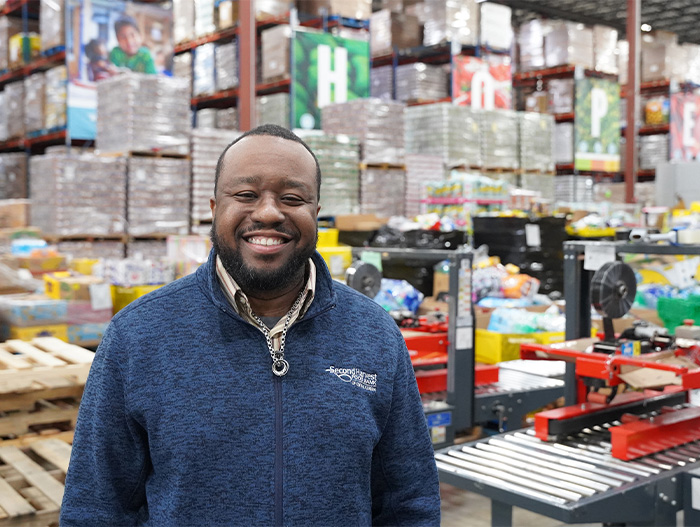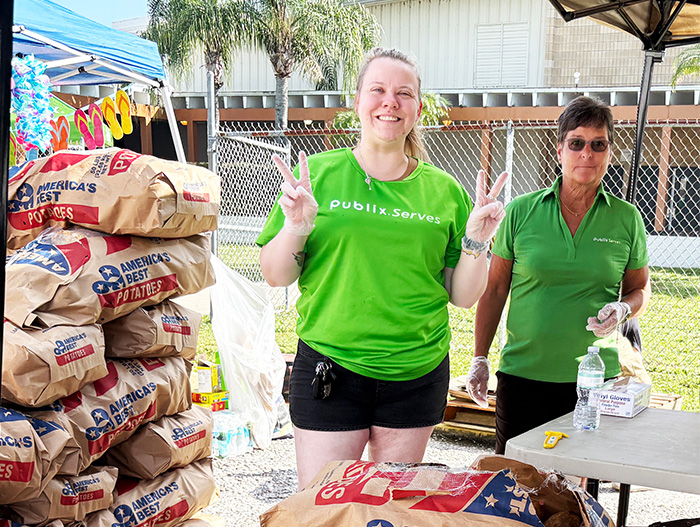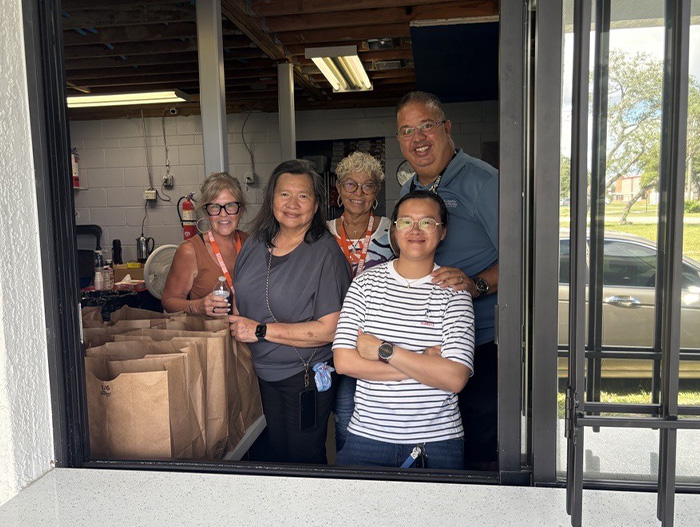


Welcome to Food Bank 101, a four-part series that answers frequently asked questions about a food bank and how it works. This introduction is aimed at establishing a basic understanding of what a food bank is and its role in a community.
Food Bank 101 Lesson 1: What is a Food Bank?
A food bank is a central hub of a hunger-relief network. Food is sourced, stored and distributed to a network of feeding partners.
“A food bank is a large nonprofit that gets food out into the community,” said Arika Richardson, Philanthropy Manager.
Second Harvest is a private, nonprofit organization that collects and distributes food to a network of more than 800 feeding partners across Brevard, Lake, Marion, Orange, Osceola, Seminole and Volusia counties.
These partners include food pantries, soup kitchens, shelters, senior centers, schools, healthcare sites and more. Mobile distributions, home deliveries and nutrition programs extend this reach even further, helping ensure that nutritious food gets to neighbors where and when it’s needed most.
What is the difference between a food bank and a food pantry?
A food bank serves as the main distribution center for large amounts of food for community-based feeding partners, including food pantries that distribute food directly to neighbors.
“A food pantry is an organization where our neighbors go to pick up food,” Arika explained. “At Second Harvest, we work with more than 800 feeding partners, all kinds of organizations ranging from schools to community centers to shelters.”
In Central Florida, the feed partner network spans seven counties and helps distribute enough food to provide 330,000 meals daily.
True or false: Is food banking just about food?
False. Hunger is connected to health, education, employment and financial stability. Addressing food insecurity typically impacts the bigger picture.
In addition to supporting neighbors facing hunger, Second Harvest has programs to address health, nutrition, education, employment and more.
“Food banking is so much more than food,” Arika said. “There are so many programs here that I’m constantly learning myself – ranging from Medically Tailored Meals to Nutrition Education to making sure people are able to get the food and resources they need.”
Lesson 2: Where Does the Food Come From?
After learning what a food bank is and its role in a community, the next question is typically: where does all the food come from?
What are the major sources of food for Second Harvest Food Bank of Central Florida?
About 50%, of the food comes from donations by the major companies in the food industry, including food manufacturers and grocers.
“We have a retail pickup program, called Grocery Alliance,” explained Chief Operating Officer Bill Collins. “We go out every day with our 24 trucks and pick up from local Publix, Target, Walmart and other grocery stores, and bring all that food back here.”
The food bank also receives donations from large national and international food companies, such as Heinz and Kraft, through Feeding America.
“Somebody like that would send a whole load of mac and cheese or whatever surplus they have right now,” Bill said.
Government commodities through USDA, as well as fresh Florida produce, dairy products and meat through Farmers Feeding Florida account for another 25%.
Second Harvest also stores and distributes food from the USDA’s The Emergency Food Assistance Program (TEFAP).
“That is basically all surplus food that the government buys to stabilize markets,” Bill explained.
The food bank also has a food purchasing program called Power Purchase, made possible by financial donations, which enables Second Harvest to obtain supplemental food items at a below-bulk rate.
Lastly, community support in the form of food drives accounts for the remaining food at Second Harvest, around another 25%.
If food stopped coming in, how long would it take to empty the warehouse?
Second Harvest distributes approximately 7.5 million pounds of food every month from its main warehouse in Orlando. There are typically around 3.5 million pounds in the warehouse at any given time.
“I checked (on a recent morning), and we have about 3.2 million pounds of food,” Bill said about the current contents of the warehouse. “So, what’s in here would be gone if we stop bringing it in in less than two weeks.”
More food is being distributed than ever and at a faster rate.
If Second Harvest didn’t rescue all this food, what would happen to it?
It’s important to understand that much of the food rescued and distributed by Second Harvest would have been thrown away and wasted otherwise. Second Harvest is a hunger relief organization and an environmentally conscious one.
“Last year, we (brought in) 100 million pounds of food,” Bill explained. “About 70 million pounds of that 100 million would probably go to the landfill. By the time we take out the truly spoiled food, it’s about 4 million pounds. So, 4% of that 100 million actually goes into the trash. The rest goes out into the community as wholesome food, ready to eat.”
Lesson 3: Where does all the food go?
It’s time for the food to be distributed into the community. The main way food leaves Second Harvest is through a feeding partner.
How many feeding partners are there?
There are more than 800 feeding partners.
“These feeding partners range from churches, community groups, group homes, treatment centers, and many other organizations that want to walk alongside us to help with food insecurity in Central Florida,” said Agency Relations Director, Patti Delacruz.
They are a large part of how large amounts of food can be distributed quickly into the community to kids, families and seniors facing hunger.
What is the agency mart?
When feeding partners arrive to pick up food orders at the main distribution center, they have their own parking area, loading docks and lobby. After checking in for their appointment, they head into a designated area of the distribution center called the Agency Mart.
“It’s a place in our warehouse where our feeding partners come to receive the food from us to be able to distribute into the community,” Patti explained. “There are many different products available for partners, such as fresh produce from (local) farms. We have frozen meat, dairy products, and we have shelf stable products.”
Partners can choose the items and quantities that best support the diet preferences and nutrition needs of their neighbors. Second Harvest implemented a nutrition ranking system in the Agency Mart called Supporting Wellness at Pantries (SWAP) to help feeding partners understand the nutritious value of each food. Items are assigned a color based on sodium, added sugar and saturated fat content as an item people are encouraged to choose often (green), sometimes (yellow) and rarely (red).
What are other ways food is distributed to neighbors in the community?
In addition to traditional food pantries and feeding partner programs, mobile distributions help get food into hundreds of households in a matter of hours.
Enough food to feed hundreds of families at a time is transported by semi-truck into targeted areas of Central Florida. Fresh produce, meat and dairy products are distributed at these large-scale food distribution events, along with pantry staple items.
“We also work with area schools where we have school pantries in each school or ways for children to take food home over the weekends,” Patti explained.
The School Partnerships Program works with schools from elementary through college-level to distribute food to students and families at on-campus School Markets.
Additional distribution programs include limited-capacity home delivery services.
Lesson 4: How Do I Help?
The final lesson explores ways to get involved with the food bank and the fight against hunger.
What are some of the ways I can get involved in the fight against hunger?
There are many ways you can make an impact on hunger relief efforts.
Whether you volunteer, donate, organize a food and fund drive, advocate, attend an event, take a tour or something else, your actions help provide food — and hope — to thousands of families, kids and seniors facing hunger.
“(Volunteering) is a great way to make a measurable, practical impact on our mission,” said Volunteer Manager Ian Dixon. “Another way you can get involved is by collecting either food or funds to support our mission.”
You can organize a traditional or virtual food drive through your workplace, school, place of worship, or community group. Every can or dollar collected helps provide meals.
Second Harvest events bring the community together to support the mission — and they are fun! Attend an upcoming event or host one of your own to support neighbors facing hunger.
Other ways to get involved include advocacy, placing an order with Plate Above Catering or visiting the food bank on a Food for Thought Tour.
What types of tasks do volunteers complete?
Volunteers help the food bank in a wide variety of ways.
“It all starts with our basic sorting or meal-packing projects, but volunteers are able to assist with a wide variety of things from office work like filing and alphabetizing to assisting with events out in the community,” Ian said. “Anytime that we have an activity that helps push forward our mission of ending hunger in Central Florida, we try to attach a volunteer component to it.
“No matter what your skill set is, no matter what your ability level is, there is a volunteer opportunity that’s fit for you.”
Thousands of volunteers contribute their time to Second Harvest each year. This incredible amount of volunteerism saves the food bank millions of dollars in labor costs annually.
“We’re able to take that money and reinvest it right back into programs and policies that help us get more food out into the community,” Ian said.
Volunteers can sign up for individual shifts or events on the food bank’s website, or they can organize a group volunteer activity with their coworkers, church group, neighbors, family or community group.
What does my financial gift provide for neighbors facing hunger?
Every dollar donated to Second Harvest is enough to provide four meals to neighbors facing hunger.
“Donating funds to Second Harvest Food Bank is a great way to make a huge impact,” Ian said. “We are able to purchase food at a capacity that far exceeds what the average consumer is (able to). And about 95 cents out of every dollar that you donate goes directly to making sure that food goes out into the community.”
A single donation can make an immediate difference for neighbors facing hunger. You can give securely online, by mail, or by phone.
Other ways to give include becoming a monthly Meal Maker, tributes or memorial gifts, donor-advised funds, planned giving, corporate partnerships and fundraising.
Learning about the food bank through the Food Bank 101 series is a great step in your journey in the fight against hunger.
“If you want to dive deeper and learn more about what we do here at Second Harvest Food Bank, please visit our website,” Ian said. “There you’ll be able to find out how you can volunteer, donate, help us advocate in the community, or just generally keep up with what we have going on in our mission.”